Monday, December 18, 2017

In Defense of Christmas Music

Music is controversial. Partially because it is a question of taste. What you love, what speaks to your soul and makes you want to dance, can mean nothing to me. Or worse, some music we actively dislike. The best way to annoy a roommate is to play their least favorite but all too catchy song and see what happens. All of this applies to Christmas music, as well. 

Some people can't stand it, even after the acceptable "post Thanksgiving" start to the Christmas season. They feel like the songs are just ear worms that stick with us. Or they are old and tired and they struggle to see the value in them. I will say this: many of the modern "Christmas-lite" or "Christmas-ish" songs can be difficult to hear over and over. Songs that ask obvious questions (yes, Mary did know, she knew, she totally knew because an angel came and told her) or don't even really have anything to say can be annoying. But amidst all of the songs talking about lights and good feelings stands a core of Christmas songs that have stood the test of time. They proclaim the core of Christian faith and remind us what we believe.

They Put Truth Center Stage

So many artists do Christmas songs, albums or videos. It seems to be the thing to do. Make a few good records and then do a "holiday" album. It is fun to see the different styles that a traditional Christmas song can take on. But something I've noticed recently is that secular artists often cover Christian Christmas songs. It is great to see solid biblical truth in the greater culture. We see popular musicians singing "Oh Come Oh Come, Emanuel!" or proclaiming "Joy to the world! The Lord is come!" It is easy to forget how little these truths are proclaimed in popular culture, and I find it exciting to see them spoken, even by those that don't believe them to be true. This is a chance for us to think deeply and praise the Lord in unexpected places.

They Connect Us to Historic Christianity

Many of the songs we sing in American churches today are not that old, relatively speaking. I know some bemoan the 80's and 90's praise choruses sung in their church, but many of our Christmas songs are from the 18th and 19th centuries. They were written by some truly great hymn writers, men and women whose songs we should sing a lot more in our congregations. "Joy to the World" was written by Isaac Watts and "Hark! The Herald Angels Sing" (though it misses the fact the angels didn't sing) was written by Charles Wesley. One of my favorite Christmas songs "Of the Father's Love Begotten" was written in the 300s. For those that struggle to find a place in many modern church music settings, the depth and beauty of these old Christmas songs can be a breath of fresh, gospel-infused air. 

They Connect Deeply to the Gospel

Often we think of the gospel as something someone needs at the beginning of their journey with Christ. It is the thing we deeply understand and accept which brings us into a relationship with Him. This is true, but the Christian that has been following Christ for 30 years needs the gospel no less than the man or woman that is just beginning. We need that reminder and the songs of Christmas are that reminder. I love to sing "O Come, All Ye Faithful" - especially the third verse. "Yea, Lord, we greet Thee, born this happy morning; / Jesus, to Thee be all glory giv'n! / Word of the Father, now in flesh appearing!" or these words "A thrill of hope, the weary world rejoices, for yonder breaks a new and glorious morning. / Fall on your knees, oh hear the angel voices"

If we take a moment to listen to all of our most well-known Christmas songs, we will hear deep truths about Christ waiting for us to reconnect with them. And that is the challenge of Christmas. We must walk down a well-worn path. One that some have been on since they were children. A path that ultimately leads to a manger and the most unique thing about Christianity. The arrival of God himself, in fulfillment of prophecy in the meekest and humblest way possible. A baby like no other who became a king like no other.

Tuesday, November 21, 2017

Family Photos

We were incredibly blessed by a fellow missionary who is a gifted photographer to get some new family pictures done recently! They turned out great and we're thankful to have some more recent photos to share and hang on the wall. Thank you, Carrie!

Here are a few of our favorites from the shoot...


Tuesday, October 31, 2017

Reformation History in Vienna

Ask an American about Austria and you probably get a fairly short list. It usually starts with Sound of Music, the Alps and maybe Schwarzenegger. Sometimes Mozart is thrown in there, and don't they speak...German there? I don't blame them, as a mid-westerner I can barely tell the difference between New Hampshire and Vermont. If people have traveled here they talk about the beautiful mountain scenery, the cute villages and the grand cities. We have palaces and castles galore, but we also have churches. A lot of churches. We have many big beautiful churches. We have very old churches and very ornately decorated ones. The next thing you learn is that almost all of them are catholic. Austria is after all a very catholic country. Most of our bank holidays are connected to some saint or someone's ascension. The protestant church is a pretty small percentage of the population, and the free church is an even smaller slice of that slice.

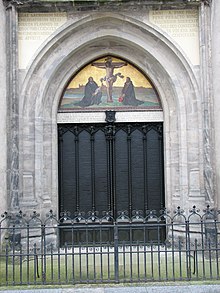
Two large black church doors with a crucifixion scene painted above with Luther and Melanchthon kneelingIn many protestant communities today is Reformation day. This is not just because they want an alternative to Halloween. On October 31, 1517 Martin Luther nailed his 95 Theses to the door of the church in Wittenberg. It was one of the definitive acts of the Reformation.

Charles V
While many people know about the German and Swiss history connected to the Reformation, it is not well known how much of a role Austria played on both sides of the Reformation story. For example, if you've seen the 2003 Luther film you may remember that Charles V was the Holy Roman Emperor that called Luther to the Diet of Worms in 1521. There Luther makes his famous statement "Here I stand, I can do no other." What we often fail to remember is that Charles V was from the Hapsburg family. They were the ones to build up the Austro-Hungarian empire. They were kinda a big deal.

On the other side of it, you have the example of a young Catholic monk that moves to Waldshut in present day Germany in 1521. In the 1500s Waldshut belonged to Austria, because in the 1500s a lot belonged to Austria. His name was Balthasar Hubmaier. He was influenced by the Swiss reformers and reads the writings of Martin Luther and comes to faith in 1523. Five years later he has planted two Anabaptist churches and baptized thousands before being martyred in Vienna. His wife is killed 3 days later. At a point in the 1500s it is said that 90% of Austria was protestant. The gospel had exploded in Austria. "Winkelprediger" - literally corner preachers would preach in the streets, in the mines, and on farms across the country. It was a truly transformational time. Even after the counter Reformation, there are villages in the mountains that remain Protestant to this day. They trace their roots back to this time.

Balthasar Hubmaier
All this to say there is an amazing tradition here in our country which we are excited to celebrate. We also pray that it will help Austrians understand that the free church is not some American splinter group. We want people to see that the values of the Reformation - Faith alone, Grace alone, the Scriptures alone - give us the chance to connect with the creator of the universe!

As we learn more about this and continue to celebrate milestones of the reformation (2021 will be the Diet of Worms, 2028 is Hubmaier's martyrdom and so on) we will continue to share with you.